From one customer question to five posts: how a small auto repair shop builds its brand with Flomixy
Your best content ideas don’t come from brainstorming. Your customers bring them to the front desk every day.
Tuesday, 8:40 a.m., at the front desk
A Golf pulls in, jerking every time it moves off. The owner is frustrated. “It’s a DQ200, the seven-speed DSG. I spent half an hour on Google and couldn’t find a single proper shop that says it works on this gearbox.”
Tom, the shop owner, nods. They fix DQ200s every week. The problem isn’t know-how. The problem is that it isn’t written anywhere.
This is the moment good content is born. And the moment most small businesses let slip.
Tom and his shop are an illustrative example.
A customer’s question is a ready-made topic
If a customer couldn’t find the answer on Google, the answer either doesn’t exist or isn’t good. That’s a gap you can fill before your competitors do.
People don’t search for “auto repair Munich”. They search for “DQ200 jerking when pulling away” or “DSG gearbox repair Munich”. These searches are rare, but they come from people who have the problem right now and are ready to pay.
One good article on that topic keeps working for you for years. The only catch: the shop owner has no time to write it.
Two minutes, from the front desk to the office
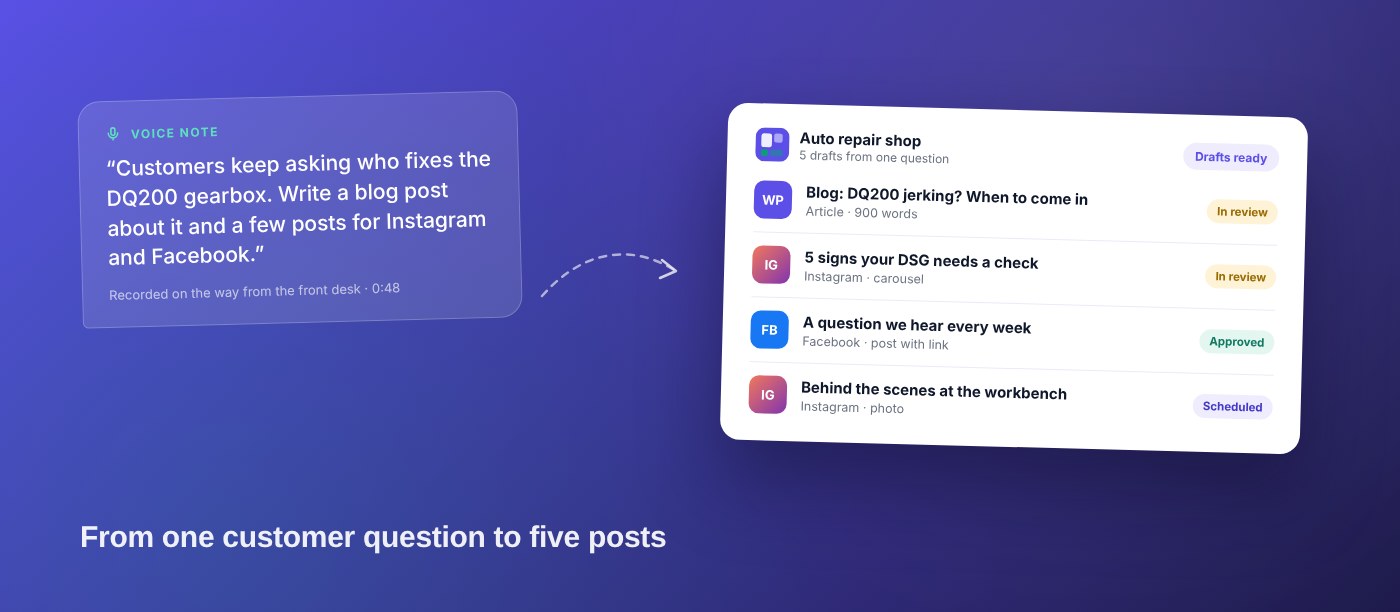
Tom doesn’t sit down at a computer. On his way to the office, he opens voice input in Claude, which is connected to his Flomixy account, and talks:
“We get a lot of cars with the DQ200 gearbox. People complain about jerking when pulling away and don’t know who to turn to. Write a blog post about the most common problems with this gearbox and when to bring the car in. Also make a few Instagram and Facebook posts on the same topic.”
By the time he reaches his desk, drafts are waiting in Flomixy:
- a blog post with a title, subheadings and a call to book a diagnostic check
- three to five social posts: symptoms, when it’s time for service, a short story from the front desk
- suggested hashtag sets and posting times
Nothing is published yet. Everything is a draft waiting for review.
Review and visuals: where AI doesn’t work alone
An article about a gearbox has to be accurate. Bad advice about the clutch or the mechatronics unit costs more reputation than it brings in customers. That’s why the draft goes for approval.
- Approver: the workshop lead checks the technical details and fixes what’s needed. If the shop works with an agency, the agency polishes the style. Flomixy records who approved what.
- Visuals, option 1: a photo from the shop floor. Nothing is more convincing than a real gearbox on a real workbench.
- Visuals, option 2: a task goes to a designer who creates graphics in the shop’s brand.
- Visuals, option 3: AI generates an illustration, or Flomixy suggests a stock photo, for those who want the fastest route.
Tom doesn’t have to track any of this by hand. He only sees the status: in review, approved, ready.
Scheduling and publishing
Once everything is approved, Flomixy slots the posts into the times when the shop’s followers engage most. The article goes on the website, and the social posts roll out over the next two weeks, each linking back to it.
The result of one morning conversation:
- one blog post aimed at an exact search
- five posts that bring people to that article
- a shop that shows up the next time someone types “DQ200 repair”
Your “DQ200” is already somewhere in your day
Every business gets questions that customers ask and the internet answers badly. A hairdresser hears them in the chair, a dentist in the waiting room, an accountant in their inbox.
You don’t need a marketing department. You need the habit of catching those moments, and a tool that turns one voice note into a draft ready for review.
Try Flomixy and turn your next customer question into your first post. Start for free